
Marcel Huijser Photography Home
This is where I show the most recent images and talk about how they were made. The images typically relate to landscapes and wildlife, but I also blog about photos of highways and mitigation measures for wildlife or road ecology in general. Please contact me if you would like to use any of the images.
All content © Marcel Huijser
Road ecology blog: wildlife warning signs for woodland caribou
Woodland caribou (Rangifer tarandus caribou) are all but gone from the lower 48 states in the USA. There is only one natural population left that roams along the boundaries of northern Idaho, north-eastern Washington and British Columbia in Canada. The herd is estimated at about 40 individuals and spends most of its time north of the border in Canada. Stagleap Provincial Park in British Columbia is especially important to this herd and in winter the woodland caribou are quite visible to people as they lick road salt along Highway 3 which cuts through the Park. Woodland caribou mainly feed on ground and arboreal lichen and the latter is especially present in old growth forests. Woodland caribou used to have a much wider distribution in the northern Rocky Mountains in Idaho, Montana and Washington and their disappearance is related to a range of issues. Changes in the landscape, including the logging of old growth forests, and predation, particularly by mountain lions (Puma concolor), are among the primary reasons for the steep decline of woodland caribou in the southern portion of their range. In addition to their effect on food availability, logging and agriculture also increased edge habitat. Edge habitat is associated with high white-tailed deer (Odocoileus virginianus) populations which in turn may have allowed for an increase in mountain lion densities. Changes in the landscape may also have allowed elk (Cervus canadensis) and moose (Alces alces) to increase their numbers, again resulting in a greater prey base for predators that also hunt caribou. Roads and other linear features, such as power line corridors, may also allow for better hunting efficiency by predators, improve access for poachers, and fragment caribou populations. In addition, caribou presence is negatively associated with snowmobiling, and sometimes caribou are hit by vehicles, including on Highway 3 at and near Kootenay Pass in Stagleap Provincial Park. Warning signs such as the one below have been placed along Highway 3 to increase awareness among drivers. Click here for other images of warning signs for woodland caribou.
Like Marcel Huijser Photography on Facebook: http://www.facebook.com/marcelhuijserphotography
All content © 2012 Marcel Huijser


Road ecology blog: painted turtle laying eggs along gravel road, Idaho, USA
Last week I visited a wetland in northern Idaho. I saw several western painted turtles (Chrysemys picta bellii) that were on the gravel road. I observed one of the turtles for a few minutes and noticed she was clearing gravel. Then she started digging a hole, right on the edge where the gravel meets the vegetation... she was going to lay her eggs! I observed the entire process which took almost exactly one hour. The digging is done with the hind legs, always alternating between the right and the left leg. I did notice the dirt was quite wet and that surprised me given the fact that the road surface seemed pretty dry. Now, after having read about the egg laying process, I think that she probably lubricated the area with her bladder water to ease the digging. I could not see every egg, but I estimate that she may have laid about 10 eggs which is close to the average clutch size (about 12) for the western painted turtle. Turtles may select nesting sites along roads because these sites are relatively high and less likely to flood, and they are also relatively warm. Since temperature influences the sex ratio of many turtle species, nesting along road sides may have an effect on the sex ratio of the hatchlings. Furthermore, nesting along roads brings direct mortality risks to both the adult females, the eggs and the hatchlings. Click here for other images of the turtle, including egg laying.
Like Marcel Huijser Photography on Facebook: http://www.facebook.com/marcelhuijserphotography
All content © 2012 Marcel Huijser

Backyard wildlife in Missoula, Montana: House finch (Carpodacus mexicanus)
There are at least three different male house finches (Carpodacus mexicanus) that visit our bird feeder. They have slightly different patterns of red on their head and chest. There is also at least one female. House finches will also sing at the feeder, similar to the American goldfinch. I wonder if they are trying to claim the feeder as part of their territory. Click here for the latest images of house finches.
Like Marcel Huijser Photography on Facebook: http://www.facebook.com/marcelhuijserphotography
All content © 2012 Marcel Huijser

Backyard wildlife in Missoula, Montana: American goldfinch (Carduelis tristis)
I think the American goldfinch (Carduelis tristis) is by far the prettiest bird that has visited our bird feeder thus far. I have counted up to three different males at the feeder at the same time. Not only do they have spectacular plumage, but they will also sing beautifully just outside my window. The female seems more cautious than the males. She will typically check out the feeder from a branch before actually landing on the bird feeder while the males seem more daring. Click here for more images of the American goldfinch.
Like Marcel Huijser Photography on Facebook: http://www.facebook.com/marcelhuijserphotography
All content © 2012 Marcel Huijser

Road ecology blog: auto repair sign in rural Montana, USA
This is a sign along a road in rural Montana advertising auto repair work. It shows a head-on collision between a white-tailed deer (Odocoileus virginianus) and a car. Wildlife-vehicle collisions take up a large percentage (up to 30 or 50% in some areas) of the crashes in rural areas in the western United States. The owner of this body shop seems to know why a good portion of his customers may be looking for someone to repair their car...
All content © 2012 Marcel Huijser

Backyard wildlife in Missoula, Montana: Eastern fox squirrel (Sciurus nigris)
Eastern fox squirrels (Sciurus nigris) are native to the eastern United States. They have gradually spread west, often actively introduced by people. In western Montana they have a patchy distribution around several cities, including Missoula and the Bitterroot Valley. They eat nuts and seeds, plants, insects and mushrooms, and they benefit from food that people leave out for them or for birds. They also eat bird eggs and young birds, which is an important reason they are now considered a problem in areas where they have been introduced. Eastern fox squirrels are abundant in urban areas like Missoula and almost everyone can see them in their backyard, on the electricity and phone lines in the alleys, or killed by a car on the city streets. Even though eastern fox squirrels are considered a conservation concern in western Montana, they do provide a connection to nature, especially for people that may not leave the city very often, and they are also just fun to watch. Click here for the latest photos of eastern fox squirrels in our backyard.
Like Marcel Huijser Photography on Facebook: http://www.facebook.com/marcelhuijserphotography
All content © 2012 Marcel Huijser

Backyard wildlife in Missoula, Montana: Rufous hummingbird with a mosquito on its bill
On 9 May 2012 I saw my first hummingbird of the year here in Missoula; a rufous hummingbird (Selasphorus rufus). The hummingbird feeder and the sugar water had a lot to do with it of course. It came back the next day and I was able to take a picture. The picture isn't very good, but when I zoomed in and looked at the image I saw something that surprised me; there was a mosquito on the hummingbird's lower beak, hanging upside down. There are several explanations for this:
1. Hummingbirds not only eat nectar; they also eat mosquitos. Perhaps the mosquito wasn't properly aligned in the hummingbird's beak and it was partly hanging out instead of having been swallowed.
2. Mosquitos, both males and females, eat nectar. Perhaps the mosquito was having a free lunch sucking nectar from the beak of the hummingbird.
3. Female mosquitos also feed on blood, including from birds. Perhaps that was why the mosquito was attached to the hummingbird, although blood can probably not be accessed from its beak.
4. Perhaps the mosquito was simply hitchhiking?
Perhaps you have other potential explanations? Fill out a comment if you want!
Like Marcel Huijser Photography on Facebook: http://www.facebook.com/marcelhuijserphotography
All content © 2012 Marcel Huijser

Road ecology blog: Spring bicycling in Yellowstone on roads closed to motorized traffic
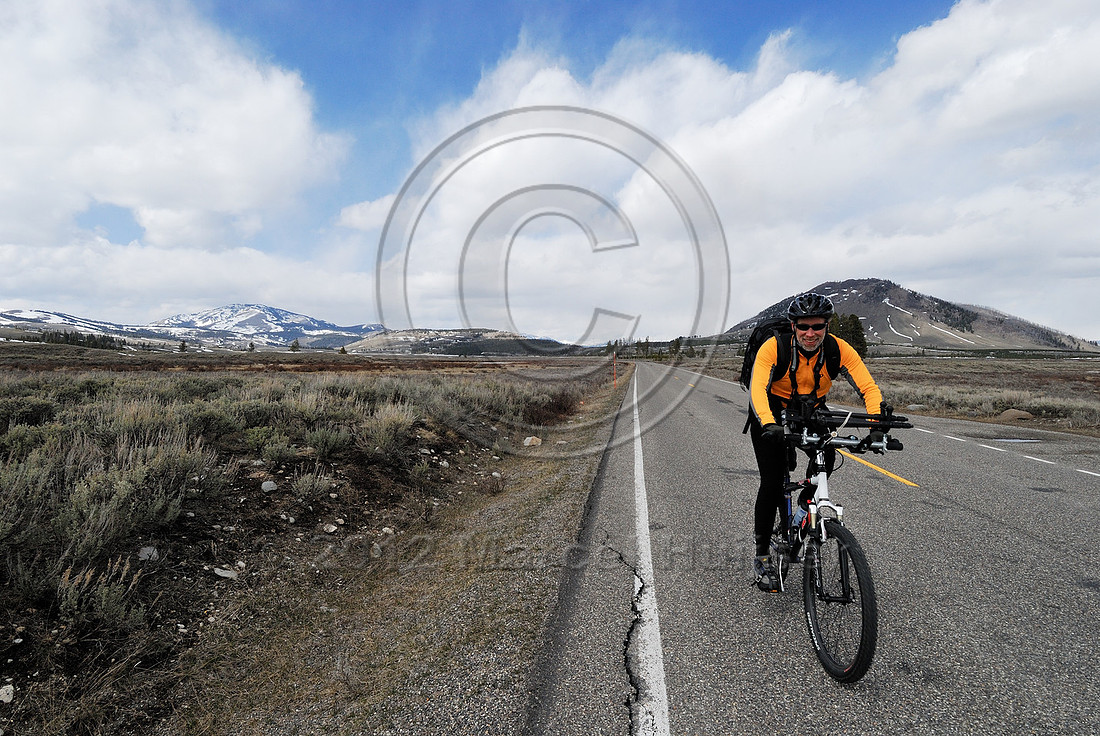
Most roads inside Yellowstone National Park are closed to cars in the winter months. After the snow has melted sufficiently and after the snowplows have cleared the roads in the spring there is a brief period (usually between mid-March and mid-April) where some roads in Yellowstone National Park are open to bicyclists and other non-motorized traffic. During this period the Park and concession staff are still preparing for the upcoming season, and the roads remain closed to cars and other motorized traffic from visitors. There are some vehicles from the Park and concession staff on the roads though. Nonetheless, this window provides a unique opportunity to experience the Park on bicycle without the typical danger and noise associated with cars that drive on the same road during the summer months. In my case I did not only want to cycle but I also wanted to take some photos along the way. The camera gear typically goes into my backpack, but I was able to strap my light weight tripod onto a rack that I attached to the handlebars. The rack is basically a gun rack that is designed for ATVs but I could also attach it to my mountain bike. Click here for more photos including road closure signs. More information from the Park on spring cycling: http://www.nps.gov/yell/planyourvisit/springbike.htm
Like Marcel Huijser Photography on Facebook: http://www.facebook.com/marcelhuijserphotography
All content © 2012 Marcel Huijser
Road ecology blog: Swing gate for horses and riders adjacent to a wildlife guard
Wildlife guards are typically designed to keep wild ungulates or livestock from getting into or getting out of an area where there is a gap in the fence for an access road. Most types of wildlife guards are difficult to pass for pedestrians or cyclists, but other designs do allow for these user groups. However, wildlife guards or cattle guards are almost always a barrier to horses and their riders. There are solutions though. The image below shows a special swing gate that was installed right next to a wildlife guard in The Netherlands. The gate allows for easy equestrian passage without requiring the rider to dismount their horse. A rider and horse that approach can simply lean on or push the gate, which comes up to the height of the rider, and then the gate will swing open as they go forward. The central post is positioned slightly out of plum on purpose. In this case it leans slightly away from the wildlife guard. It must lean parallel to the direction of the fence in order to work properly. The gate swings around this central post and because of gravity, the post will close automatically behind the horse and the rider in line with the fence. This particular fence, wildlife guard and swing gate are designed to keep red deer (Cervus elaphus) from leaving a fenced area. Click here for additional images.
Like Marcel Huijser Photography on Facebook: http://www.facebook.com/marcelhuijserphotography
All content © 2012 Marcel Huijser

Road ecology blog: wildlife guard and gate at access road
A few weeks ago I showed images of a wildlife guard that was constructed with modified bridge grate. Modified bridge grate is more comfortable to drive over than the bars or tubes used in standard cattle guards. Bridge grate material is typically used where traffic volume and vehicle speeds are relatively high and if there is relatively frequent use by bicyclists and pedestrians. However, a wildlife guard constructed with bridge grate material is more expensive than one that uses standard metal bars or tubes. The image below is an example of a standard wildlife guard. In this particular context its purpose is to discourage white-tailed deer and other ungulates from accessing the fenced road corridor. Click here for additional images, including photos of a gate next to the wildlife guard. The gate allows pedestrians or cyclists to pass through the fence.
All content © 2012 Marcel Huijser

Backyard wildlife in Missoula
I decided to build a bird feeding station in order to be able to see and enjoy the birds that fly around in our neighborhood in Missoula, Montana. Of course I also wanted to photograph them. This is a house finch (Carpodacus mexicanus), but you can click here to see images of other wildlife species that visited our backyard this week.
All content © 2012 Marcel Huijser

Road ecology blog: Wildlife underpass and overpass, US Hwy 93 on Flathead Indian Reservation
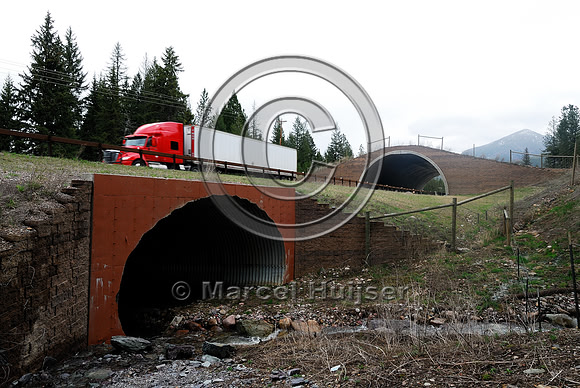
Most of the wildlife underpasses along US Hwy 93 on the Flathead Indian Reservation in Montana are elliptical metal culverts that are about 7 m wide and 4-5 m high. This particular wildlife underpass is located near Evaro and not only allows animals to pass safely underneath the highway, but there is also a stream that flows through the structure. The wildlife overpass is in the background. Both the underpasses and the overpass are used by a wide variety of species. More information, including images of animals using the structures can be found at the following websites:
Outreach through People's Way Partnership: http://www.peopleswaywildlifecrossings.org/
Like the work of the People's Way Partnership on facebook: http://www.facebook.com/US93PeoplesWay
Montana Department of Transportation: http://www.mdt.mt.gov/research/projects/env/wildlife_crossing.shtml
Confederated Salish and Kootenai Tribes: http://www.cskt.org/wlc.htm
Western Transportation Institute at Montana State University: http://www.westerntransportationinstitute.org/research/roadecology/specialprojects.aspx
All content © 2012 Marcel Huijser
Road ecology blog: Root wad of tree pulls up wildlife fence
All trees eventually fall down. When a tree falls down damage can occur to whatever surrounds the tree. In this case a wildlife fence was placed alongside a highway through a forested area. The trees immediately behind the fence reduce the visibility of the fence and improve landscape aesthetics. It is obvious that trees located close to a fence can damage that fence when they fall. The damage usually occurs when a tree stem falls on top of a fence. This image shows a different situation where an entire tree was uprooted, where the tree stem did not fall on the fence, but where the root wad lifted the fence up, damaging it from the bottom up rather than from the top down. Click here for additional images.
All content © 2012 Marcel Huijser

Road ecology blog: fence markers or flags for sage grouse
Sage grouse (Centrocercus urophasianus) populations in North America are under pressure from a range of issues. Some of these threats are related to roads and traffic. Sage grouse are sometimes hit by cars, but they can also collide with right-of-way or livestock fences. Markers or "flags" are used to make these fences more visible to fast and low flying sage grouse. The markers or flags can reduce fence strikes by 70% or more and they are especially recommended in areas with relatively high population densities and near leks where sage grouse concentrate during the mating season. More information about different types of fence markers and other sage grouse conservation efforts can be found at: http://sagegrouseinitiative.com/. Click here for additional images of fence markers.
All content © 2012 Marcel Huijser

Road ecology blog: Red squirrel (Tamiasciurus hudsonicus) on the yellow stripes
I found this dead red squirrel (Tamiasciurus hudsonicus) on the center lines. There was no blood, just the characteristic dead eyes. More images at: http://marcelhuijser.zenfolio.com/roadkilledanimals/h39fd7e1e#h39fd7e1e
All content © 2012 Marcel Huijser
