
Marcel Huijser Photography Home
This is where I show the most recent images and talk about how they were made. The images typically relate to landscapes and wildlife, but I also blog about photos of highways and mitigation measures for wildlife or road ecology in general. Please contact me if you would like to use any of the images.
All content © Marcel Huijser
Brazilian birds: I am Brazil... unapologetically beautiful !
I am Brazil... unapologetically beautiful.
There is something about macaws... they are so spectacularly colored, beautiful and smart that they continue to blow my mind. I never get bored looking at them and seeing them interact with each other. They typically announce themselves by their loud calls and you will almost always see them flying in pairs.
With the first image (see below) I lucked out because I was able to get very close and was ready when the first sun beams hit the birds. Just spectacular colors! The second image was a few days later with the sun higher in the sky. High shutter speed was essential to "freeze" the birds at the right moment with their wings spread out.
Image below: Blue-and-yellow macaw (Ara ararauna) in first sunlight, Parque Nacional das Emas, Goiás, Brazil
Click here for more images of Parque Nacional das Emas.
Some large format prints (limited edition) are now for sale at Freshwater Studio & Gallery in Missoula, Montana.
Like Marcel Huijser Photography on Facebook
All content © 2015 Marcel Huijser
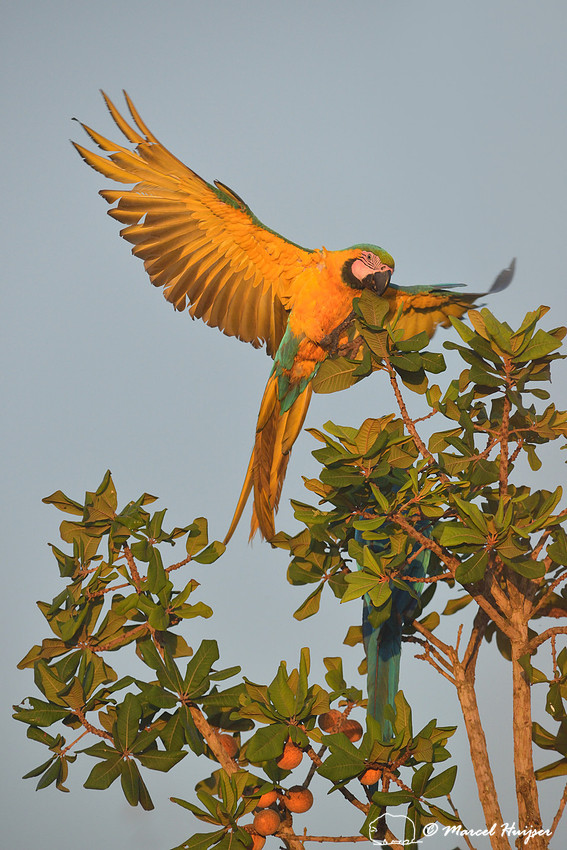

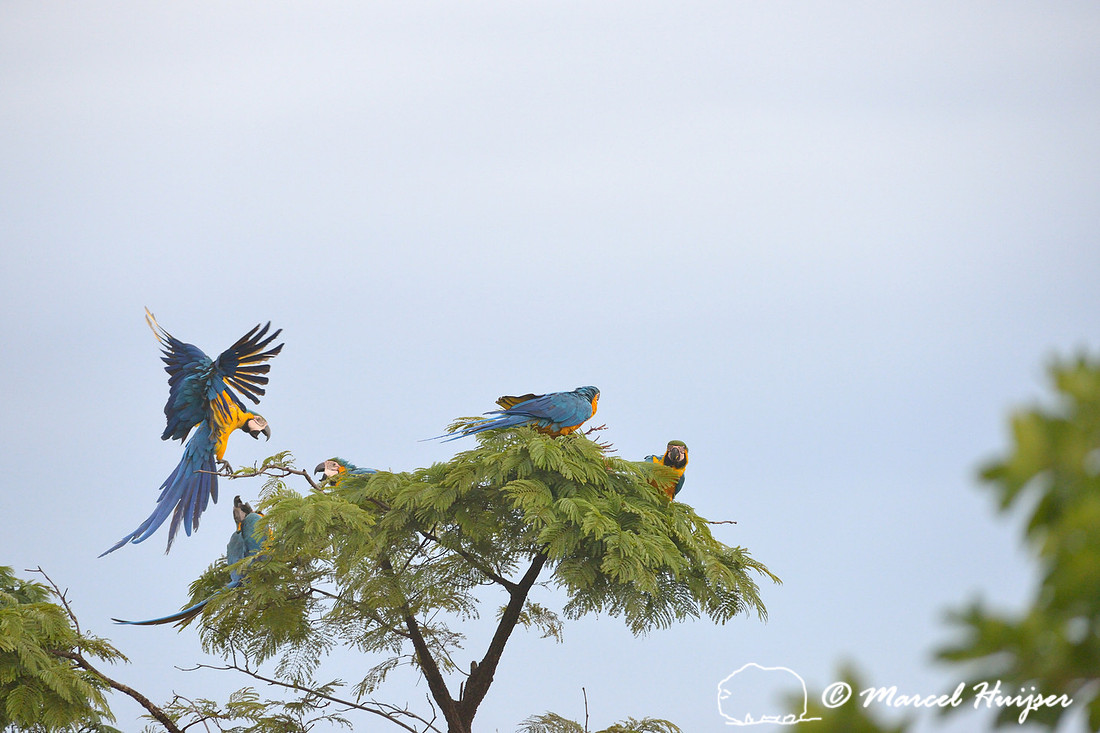
Image below: Blue-and-yellow macaws (Ara ararauna), Parque Nacional das Emas, Goiás, Brazil
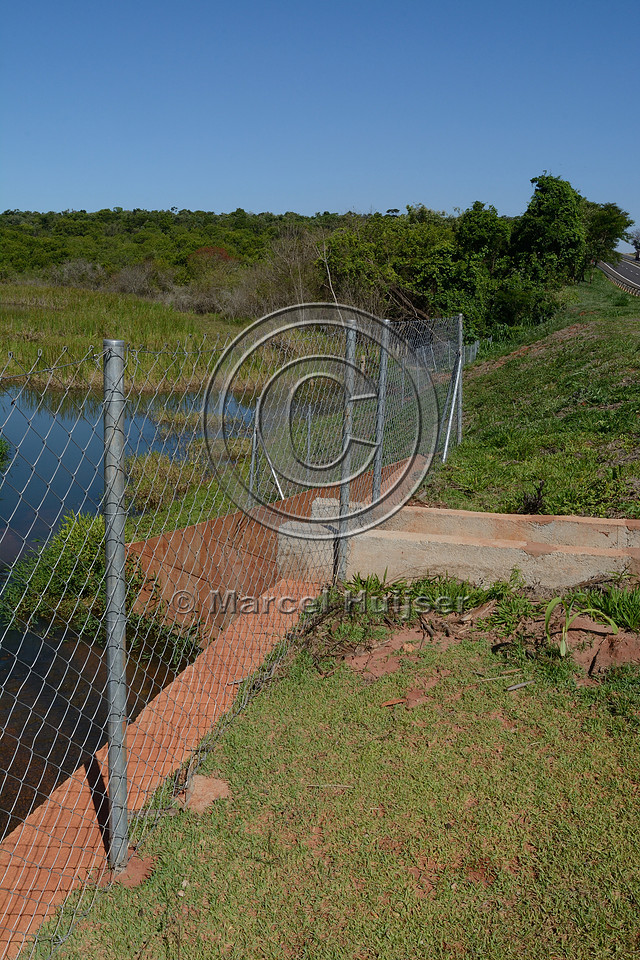
Road ecology blog: Drainage from road under wildlife fence at underpass, São Paulo, Brazil
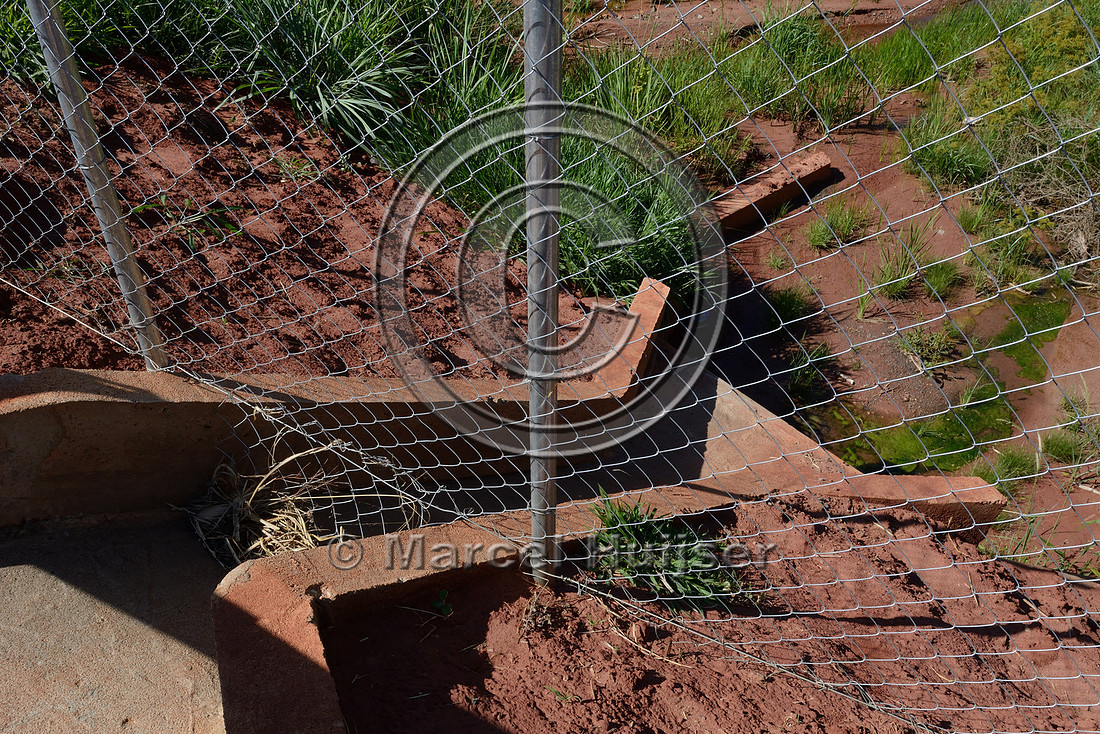
Drainage from road under wildlife fence at underpass, SP-270 about 70 km south east of Presidente Prudente, São Paulo, Brazil. Drainage can be hard to combine with a wildlife fence as it may result in an opening in the fence allowing certain species to access the fenced road corridor. In the images below the drainage is positioned right above multifunctional underpasses (water, wildlife). There are pros an cons associated with this approach:
Pros:
1. This may reduce intrusions of wildlife into the fenced road corridor as it is harder for wildlife to access the gap under the fence.
2. Depending on the construction it may be harder for vegetation to eventually block the gap under the fence and plug the drainage gutter.
Cons:
1. If it is a multi-functional underpass including for water, I would recommend against draining run-off from the road directly into a stream, or river. Pollutants (e.g. from road surface, particles from tires) and sediments are likely to be present in the run-off. In my opinion it is best to not drain road run-off directly into streams and rivers. It is better to drain road run-off into (artificial) depressions where it can percolate into the soil. The soil and microbes can then filter out or break down the pollutants and sediments before they get into the stream.
2. If it is a multi-functional underpass including for water, I would recommend against draining any unnaturally concentrated water directly into a stream. Concentrating water and dumping it into a stream or river increases peak flows and increases the risk of flooding down stream. This is especially important when rain events are severe (heavy downpours) and when such events may become more common in the future(climate change). It is better to drain road run-off into (artificial) depressions where it can percolate into the soil. As a consequence it takes more time for the water to reach the stream and the water does not reach the stream all at the same time.
3. In other situations the underpass may not have a stream or river, and the structure may be only or mostly intended for wildlife. However, when it rains, it results in a temporary "waterfall" at the entrance of the underpass. I really do not know if this affects wildlife use or not. "Falling water" may deter wildlife during a rain storm, but a puddle (after a rain storm) may be an attractant. However, because of the pollutants in road run-off it is not advisable to encourage wildlife to drink this type of water.
4. In a "dry" underpass a hard (potentially artificial) surface is needed to prevent erosion where the water hits the ground. However, the surface in front of and inside an underpass should preferably match the natural soil of the surroundings though.
Click here for more images of erosion and erosion control measures.
Like Marcel Huijser Photography on Facebook
All content © 2015 Marcel Huijser
Big Bird
Brazilian birds: Greater rhea (Rhea americana) in soy field, Goias, Brazil. Near threatened (IUCN, 2015).
Click here for more images of Parque Nacional das Emas.
Some large format prints (limited edition) are now for sale at Freshwater Studio & Gallery in Missoula, Montana.
Like Marcel Huijser Photography on Facebook
All content © 2015 Marcel Huijser

Road ecology blog: Wildlife fence east of Presidente Prudente, São Paulo, Brazil
Road ecology blog: Wildlife fence, SP-270 about 70 km south east of Presidente Prudente, São Paulo, Brazil.
Click here for more images of wildlife fencing.
Like Marcel Huijser Photography on Facebook
All content © 2015 Marcel Huijser


Road ecology blog: Multi-functional underpasses (water, wildlife), São Paulo, Brazil
Road ecology blog: Multi-functional underpasses (water, wildlife), SP-270 about 70 km south east of Presidente Prudente, São Paulo, Brazil
When possible it is best to build a structure that has no bottom as this allows for natural stream dynamics (e.g. bottomless culvert or overspan bridge). To make a stream crossing also suitable for different wildlife species, it is best to include space for semi-aquatic species (riparian zone) and terrestrial species (dry zone) rather than only for aquatic species (wet zone). Finally, it is best to not have dividing walls inside the structure and allow for greater visibility for wildlife inside and through the structure. Note that there are South American tapir (Tapirus terrestris) in the immediate vicinity of structure shown in the second image and that several have been hit at this location over the last few years.
Click here for images of other multifunctional underpasses.
Click here for more images of wildlife underpasses.
Like Marcel Huijser Photography on Facebook
All content © 2015 Marcel Huijser


Brazilian wildlife: White-lipped peccary (Tayassu pecari), Parque Nacional das Emas
Brazilian wildlife: White-lipped peccary (Tayassu pecari), Parque Nacional das Emas, Goiás, Brazil.
Click here for more images of Parque Nacional das Emas.
Some large format prints (limited edition) are now for sale at Freshwater Studio & Gallery in Missoula, Montana.
Like Marcel Huijser Photography on Facebook
All content © 2015 Marcel Huijser

Life in Brazil: no sweat...
Image below: just a few weeks ago; all play, no sweat... except it is 35C with high humidity and I am sweating profusely !
Canoeing in Saco do Mamangua, Rio de Janeiro, Brazil. No roads, the only access is over the water. From left to right: Fernanda Abra, Bethanie Walder, and Luiz Antonio (Gambá).

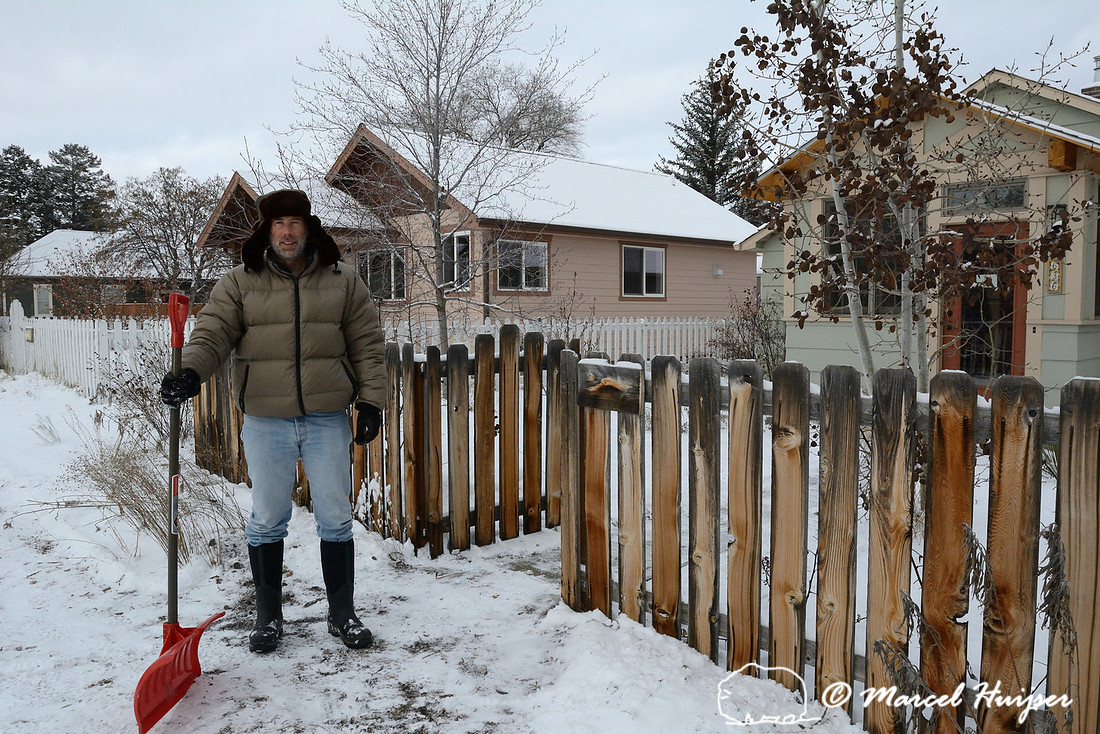
Image below: Today; shoveling snow with -17C and I am still sweating !
Marcel Huijser shoveling snow in Missoula, Montana, USA.
Click here for more images of Saco do Mamangua.
Some large format prints (limited edition) are now for sale at Freshwater Studio & Gallery in Missoula, Montana.
Like Marcel Huijser Photography on Facebook
All content © 2015 Marcel Huijser
Capoeira, São Paulo State, Brazil
Text by Bethanie Walder
We had a great plan one weekend in November; to visit Parque Estadual do Morro do Diabo, in western Sao Paulo state. But things in Brazil often don’t work out as planned. We found out at the last minute that the park will be closed on Monday, which was the only day we could visit (we’ll be nearby for a roads/wildlife workshop where Marcel will be presenting).
While Marcel stayed in the apartment to work on his presentation, I decided to take an afternoon walk around Rua do Porto and Engenho Central (an old sugar cane factory that is now a cultural center for Piracicaba). There’s almost always a festival of some sort at Rua do Porto on the weekends, and this weekend it was a combined cachaça and seafood festival (though I’m not sure it’s such a great idea to combine large quantities of these two items). As I finished my circuit between the two bridges, I passed by the Casa do Povoador – a renovated house along the river that often has art exhibits – and the small ampitheater outside, where a a capoeira presentation was about to begin. I first noticed people holding strange musical instruments, and then I noticed the many capoeiristas mulling about dressed in white pants and white or blue t-shirts. If I understood correctly (I never know if I completely understand what people are saying in Portuguese), the capoeiristas were from four different schools (two from Bahia state, one from São Paulo and one from Piracicaba). From the quick research I did online, it seems that this was a roda de capoeira (basically a capoeira circle with music and two capoeiristas at a time “playing” capoeira inside the circle).
I went back to the apartment, grabbed Marcel (and he grabbed his camera), and we spent an hour or so watching capoeira and listening to music. According to Wikipedia, “capoeira instruments are disposed in a row called bateria. It is traditionally formed by three berimbaus, two pandeiros, one atabaque, one agogô and one ganzá.” I’m not sure whether this group had all of those instruments, but it had most of them. The music truly set the stage for the performance, and was usually call and response, with the singing from the crowd as important as the singing from the musicians (and the musicians regularly switched out with the people performing capoeira as well).
Yes, we were disappointed that we didn’t get to go to Morro do Diablo. But it was pretty awesome to get to watch a roda de capoeira – after all, capoeira is one of the most well-known aspects of Brazilian culture, and we hadn’t happened upon anything like this before. Even though things often don’t work out exactly as planned in Brazil, if you’re open-minded and patient, you never know what might happen instead.
Note: this slide show contains audio. The audio may not play on certain mobile devices.

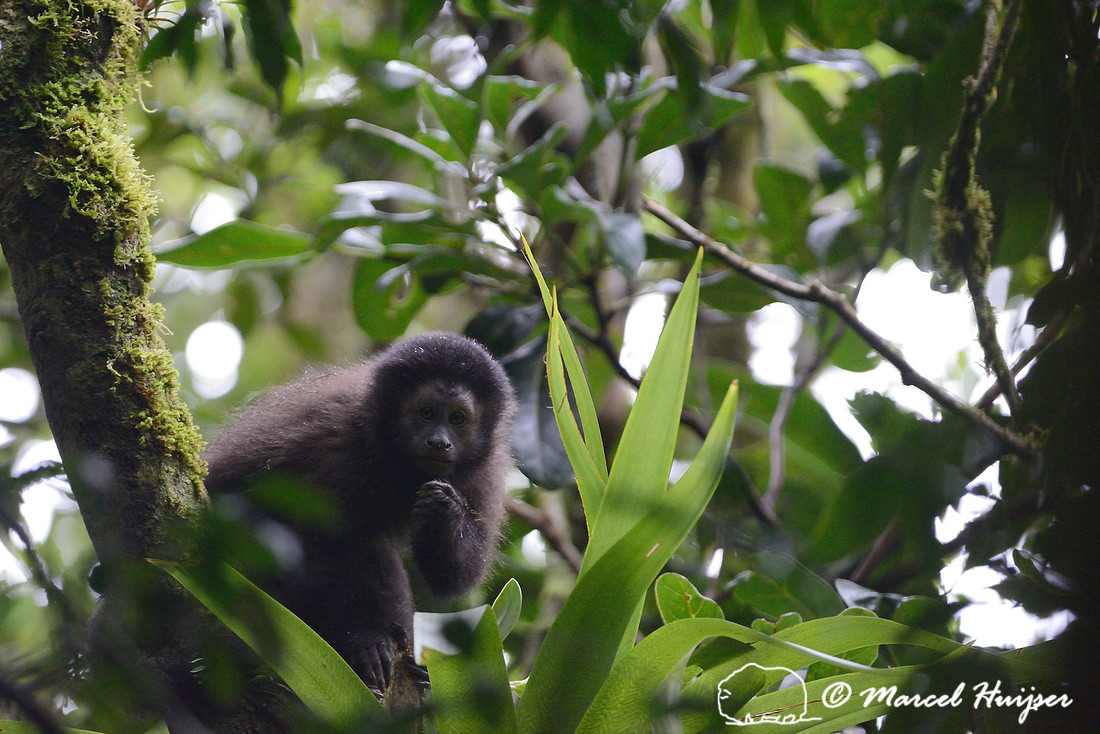
Brazilian wildlife: Black horned capuchin, Parque Estadual Carlos Botelho, São Paulo
Brazilian wildlife:Black horned capuchin (Sapajus nigritus nigritus), Atlantic rainforest, Parque Estadual Carlos Botelho, São Paulo State, Brazil
Click here for more images of Carlos Bothelho State Park, Brazil.
Some large format prints (limited edition) are now for sale at Freshwater Studio & Gallery in Missoula, Montana.
Like Marcel Huijser Photography on Facebook
All content © 2015 Marcel Huijser
Brazilian wildlife: Ihering's Fathead Anole and Willian, Parque Estadual Carlos Botelho
Brazilian wildlife: Ihering's Fathead Anole (Enyalius iheringii) and our guide Willian, Atlantic rainforest, Parque Estadual Carlos Botelho, São Paulo State, Brazil.
Click here for more images of Carlos Bothelho State Park, Brazil.
Some large format prints (limited edition) are now for sale at Freshwater Studio & Gallery in Missoula, Montana.
Like Marcel Huijser Photography on Facebook
All content © 2015 Marcel Huijser


Parque Nacional das Emas
Many thanks to Marcos and Ana Luzia from Pousada do Glória and Joel Jesus Silva and Karolyne Rodrigues from Adventure Services for a fantastic time in Parque Nacional das Emas; obrigado!
Image below: Marcel Huijser, Bethanie Walder, Ana Lúcia, Karolyne Rodrigues and Joel Jesus Silva at Pousada do Gloria near Parque Nacional das Emas, Goiás, Brazil

Image below: Karolyne Rodrigues (Onça-pintada or jaguar, Panthera onca), Marcel Huijser (ratão-do-banhado or Coypu, Myocastor coypus), Bethanie Walder (tatu canastra or giant armadillo, Priodontes maximus) and Joel Jesus Silva (veado-campeiro, pampas deer, Ozotoceros bezoarticus, Parque Nacional das Emas, Goiás, Brazil.

Road ecology blog: Hollow dirt road, Minas Gerais, Brazil
Road ecology blog: Hollow dirt road (erosion), near São José do Barreiro, Parque Nacional da Serra da Canastra, Minas Gerais, Brazil.
Click here for more images of erosion and erosion control measures.
Like Marcel Huijser Photography on Facebook
All content © 2014 Marcel Huijser

Researchers at work: Some of the cool road ecology people I work with in Brazil
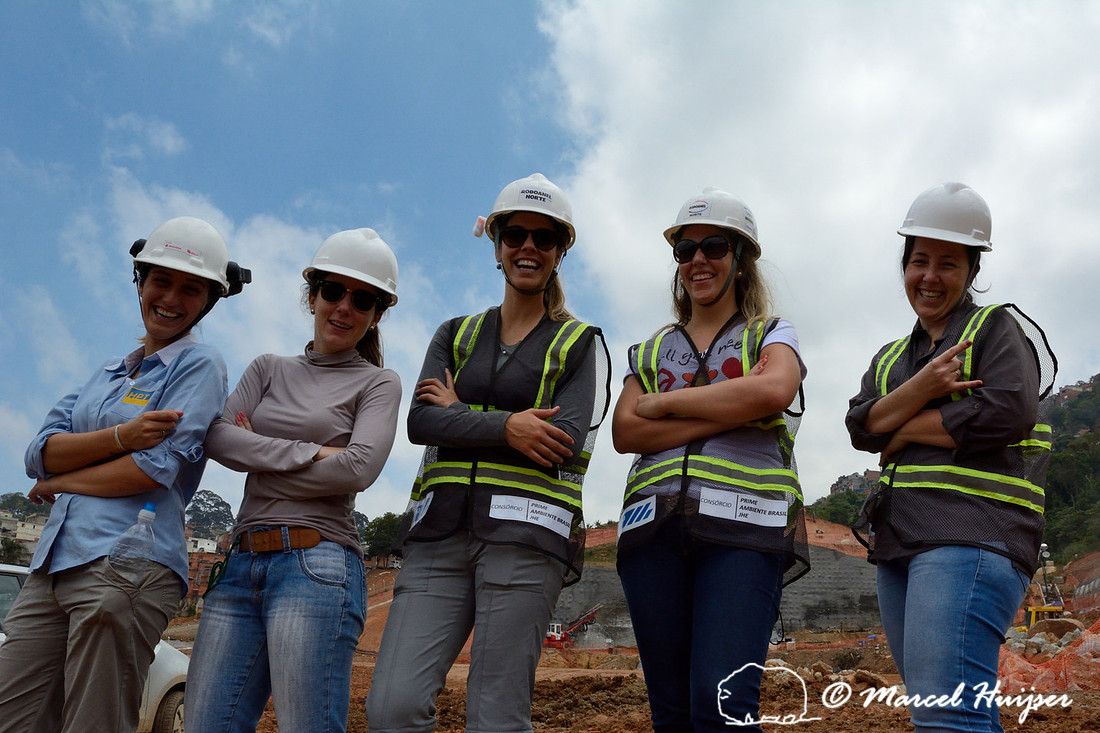
My work in Brazil is coming to an end... at least for now! :) Here are some of the cool people I got to work with. From left to right: Camylla Silva Pereira, Jamille Consulin, Fernanda Abra, Ana Scivittaro Cruz and Katia Ferraz, Rodoanel Norte construction project, São Paulo, Brazil.
Thanks everyone, até mais!
Brazilian wildlife on and near highway SP-225, near Brotas, São Paulo, Brazil
Brazilian wildlife on and near highway SP-225, near Brotas, São Paulo, Brazil.
Image below: Ratão-do-banhado or coypu (Myocastor coypus), near Brotas, São Paulo, Brazil.
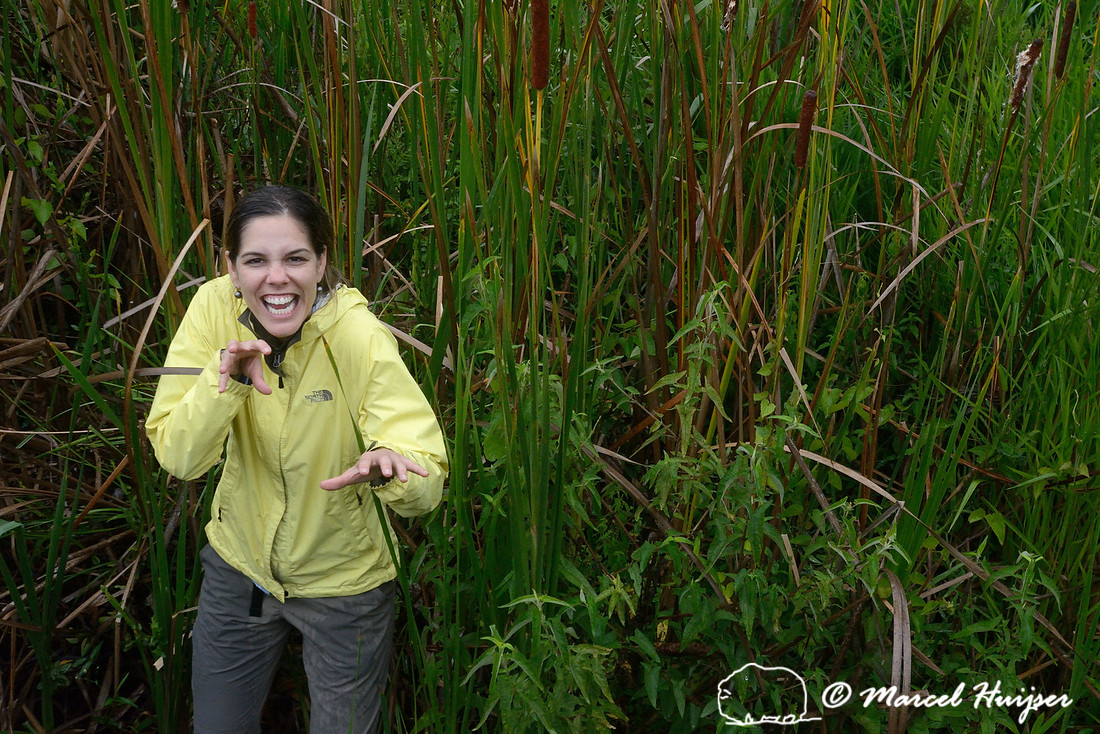
Image below: Veado sp. (Cervidae), near Brotas, São Paulo, Brazil
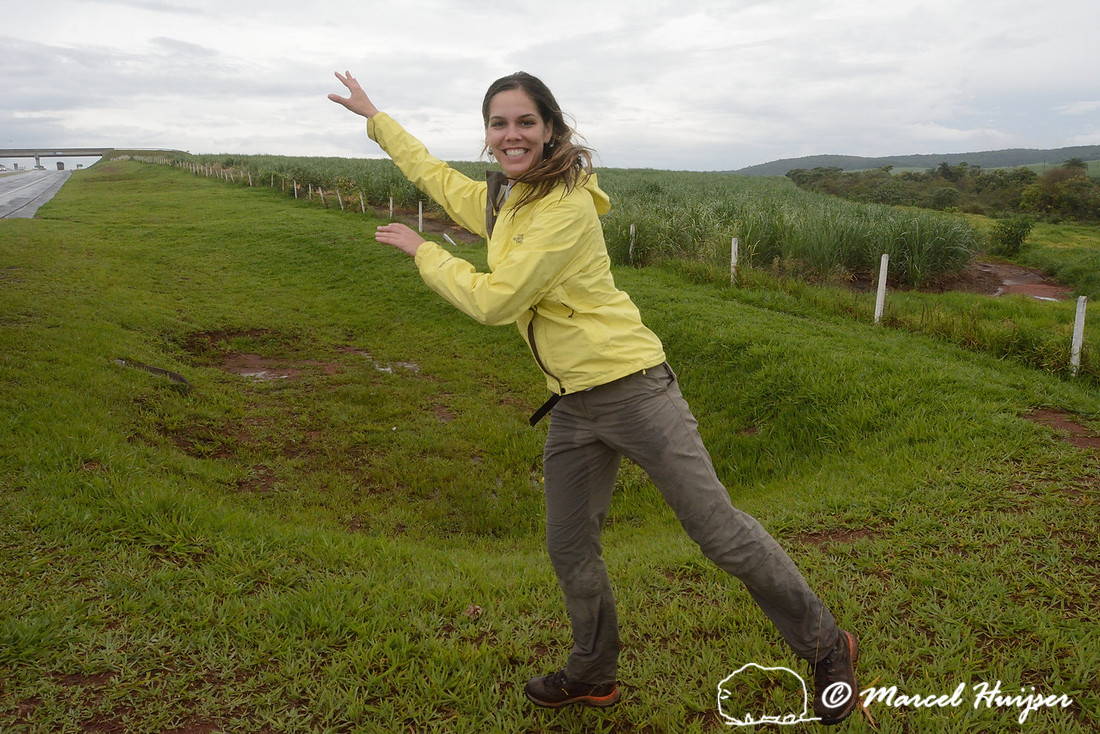
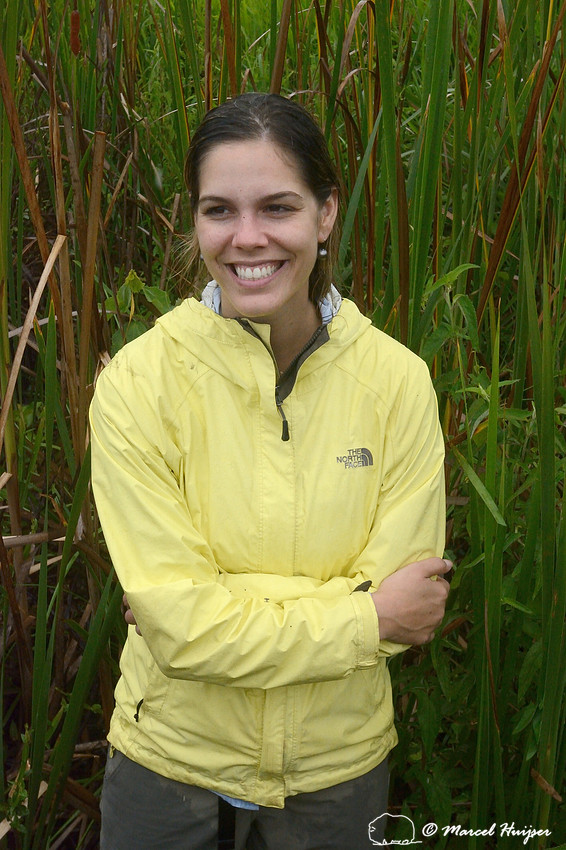
Image below: Fernanda Abra, PhD student ESALQ, University of São Paulo, Brazil
Click here for more images of Serra da Canastra National Park.
Some large format prints (limited edition) are now for sale at Freshwater Studio & Gallery in Missoula, Montana.
Like Marcel Huijser Photography on Facebook
All content © 2014 Marcel Huijser
Spider, Parque Nacional Serra da Canastra, Minas Gerais, Brazil
Spider, Parque Nacional Serra da Canastra, Minas Gerais, Brazil.
Click here for more images of Serra da Canastra National Park.
Some large format prints (limited edition) are now for sale at Freshwater Studio & Gallery in Missoula, Montana.
Like Marcel Huijser Photography on Facebook
All content © 2014 Marcel Huijser

