
Road Ecology blog: Edge habitat on top of multifunctional overpass, Parndorf, Austria

Road Ecology blog: Edge habitat on top of multifunctional overpass (wildlife and farm road, about 100 m wide), across A4 motorway, Parndorf, Austria.
While we often design wildlife crossing structures for specific species (the "target species"), it is best to provide a crossing opportunity that is suitable for a wide array of species that may be present in the landscape. If a structure is large enough we can increase the performance of the structure to where it is not just about providing connectivity for selected animal species. It is about allowing ecosystem processes to continue despite the presence of a road. Ecosystem processes may include physical processes (e.g. those related to soil and water), as well as biological processes (wildlife movements, seed dispersal of plants). If the landscape and ecosystem processes are to continue over or under the road, then it basically means that the vegetation, soil and water continue. This may only be possible in road sections with very long bridges or tunnels. However, even on a narrower structure, e.g. a 50-100 m wide wildlife overpass, we can strive for this by ensuring that different habitat types, characteristic for the surrounding landscape, are present on top of the structure. These habitat types may include cover (shrubs and small trees), open habitat (grass-herb vegetation and bare sand), and edge habitat (transition between cover and open habitat). In this context the size of a crossing structure can be based on the space that would be needed to provide the different habitat types rather than what the minimum dimensions are for selected target species.
Click here for images of other multi-functional overpasses.
Like Marcel Huijser Photography on Facebook
All content © 2014 Marcel Huijser
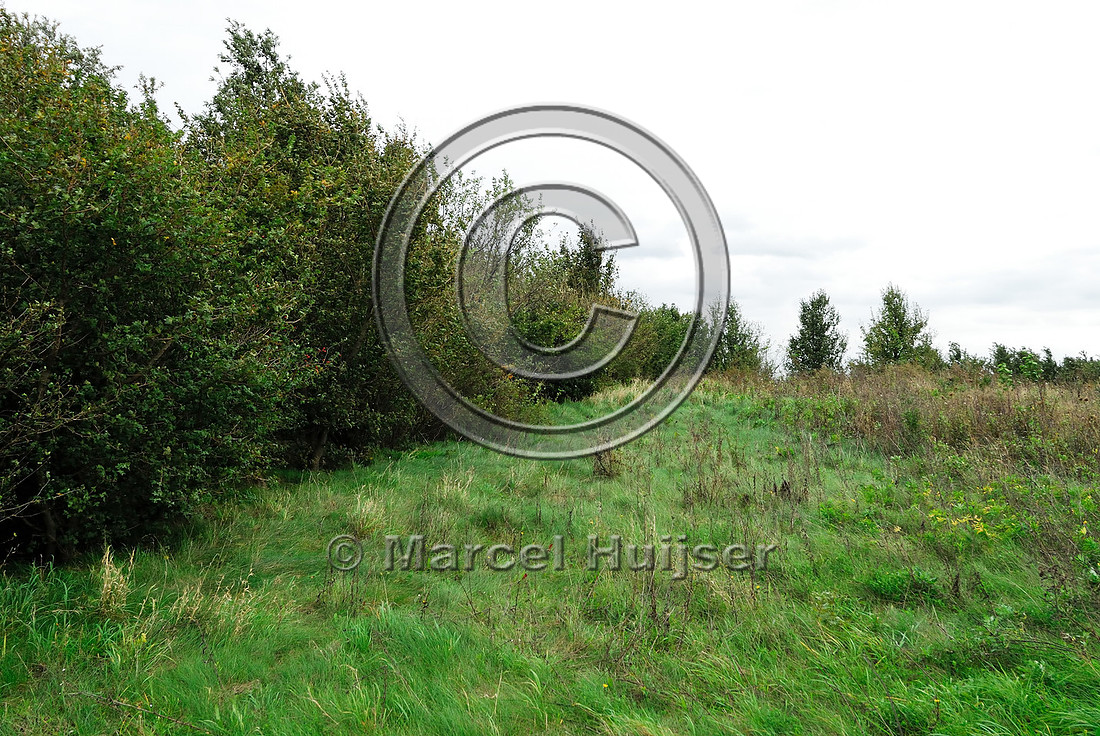 Edge habitat on top of multifunctional overpass (wildlife and farm road, about 100 m wide), across A4 motorway, Parndorf, AustriaEdge habitat on top of multifunctional overpass (wildlife and farm road, about 100 m wide), across A4 motorway, Parndorf, Austria. The overpass is designed for farmers, agricultural machinery, hunters and wildlife including roe deer (Capreolus capreolus) and European hare (Lepus europaeus).