
Road ecology blog: Modification for wildlife guards

Wildlife fencing of the correct height and type is generally very effective in keeping large mammals from accessing highways and wildlife fencing reduces wildlife-vehicle collisions substantially. However, in multi-functional landscapes there is a need for access roads which means that there will be gaps in the fence. Wildlife guards can reduce wildlife intrusions into the fenced roadway at these gaps in the fence. Wildlife guards are very similar to cattle guards, but they are specifically designed for wildlife species, e.g. for white-tailed deer and mule deer. One type of wildlife guard is shown in the image below. While this particular design is a substantial barrier for deer (about 9 out of 10 deer that approach the guard do not cross the guard), some deer do end up crossing the guard. Some of the deer use the concrete ledge at the side of the metal bridge grate. The rubber flaps shown in the image were designed and installed by the Montana Department of Transportation to make it more difficult for deer to walk across the concrete ledge and then enter the fenced highway. At this time it is unknown how effective the rubber strips are in blocking deer from using the concrete ledge. Click here for more images of the wildlife guard.
All content © 2012 Marcel Huijser
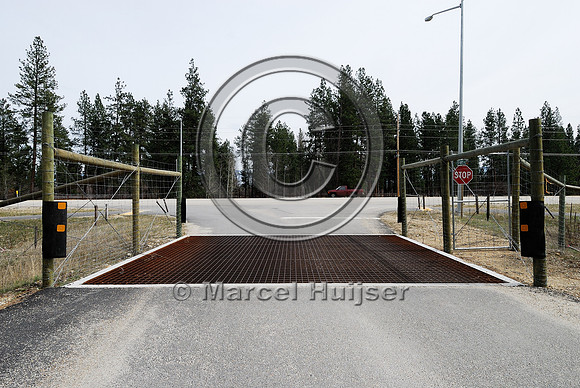 Rubber strips at a wildlife guard installed to make it more difficult for deer (Odocoileus spp.) to walk across the concrete ledge and access the highway, near Stevensville, Montana, USA